Sponsored Project
Research
Design
canopy walk
Team :
Chielota Uma, Johnny Nguyen, Cathy Lin
Final Deliverable :
5 Educational Interactive Prototypes
Project Duration :
Aug 2025 -> Dec 2025 | 17 Weeks
Methodology :
Co-Design, Iterative Testing, Physical Prototyping
At a Glance
How can immersive design thrive within physical limits?
The Georgia Aquarium is expanding the Peterson Freshwater Preserve with Canopy Walk, a new exhibit connecting three treehouses via rope bridges. Our task was to design an engaging ecosystem experience for children (ages 5-8) that manages high crowd flow and utilized space efficiently.
So we designed a four-stage user journey that guides children through the tree life cycle and ecosystem dynamics. The experience integrates five hybrid digital-physical touchpoints, each gamifying specific educational concepts to increase engagement and retention.
research & discovery
contextual & Physical Analysis
The Canopy walk will have 3 different tree house themed play areas for children to learn and explore the tree canopy system. The exhibit structure presents three main constraints in our project:
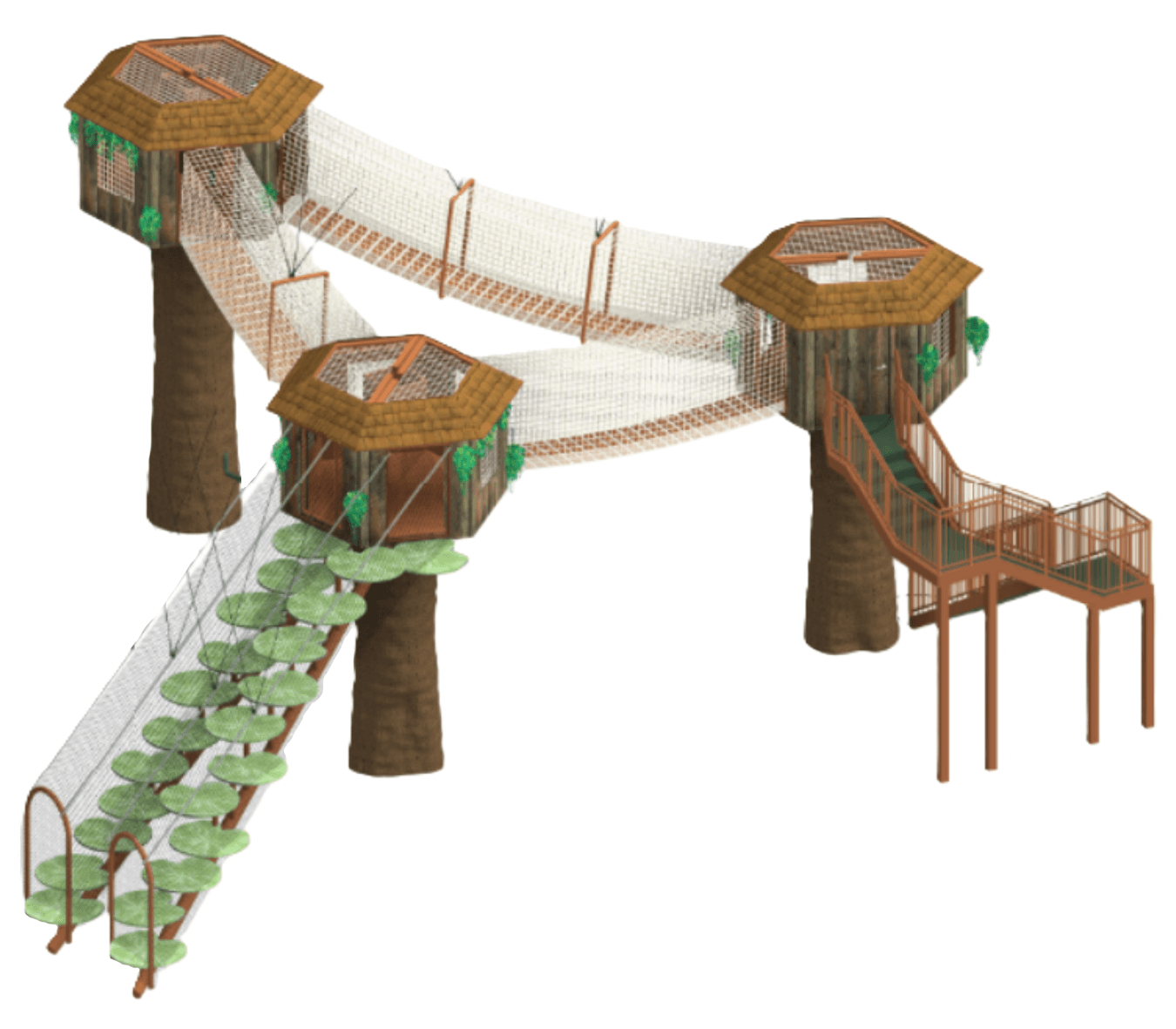
Diagram from Georgia Aquarium



The first house is bisected with
separate entry and exit points,
requiring a strict one-way linear flow.
NO BACKTRACKING
NO BACKTRACKING
Interactions must conclude within
a 3-5 minute window to avoid
overcrowding.
TIME PRESSURE
Each treehouse has a 12ft diameter
and a central support beam.
LIMITED SPACE
conducting MIXed METHODs
To understand how to thoughtfully design accessible interactive exhibits for children and how what makes an interaction fun, accessible & educational.
5
LIT REVIEWS
13
INTERVIEWS
7
OBSERVATION
SITES
70
SURVEY
RESPONSES
42
CO-DESIGN
DRAWINGS
mY main ROLE IN THIS PHASE…
was to analyze research papers, collect surveys, engage in ethnographic observations, and conduct interviews.
i lead 2 co-design sessions…
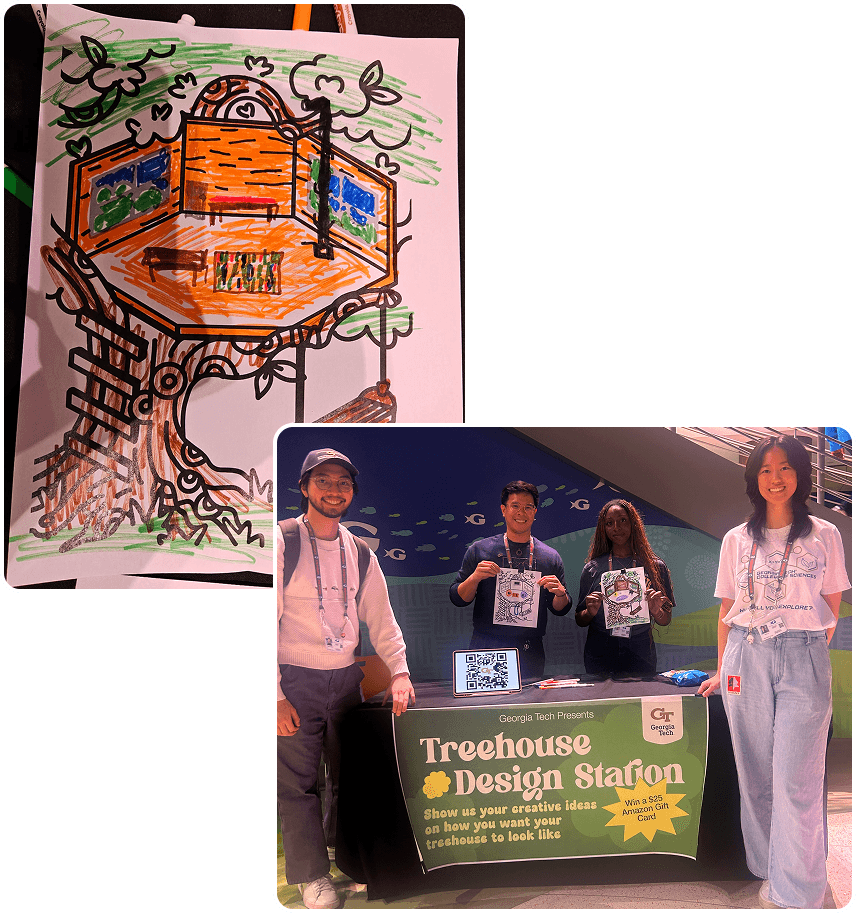
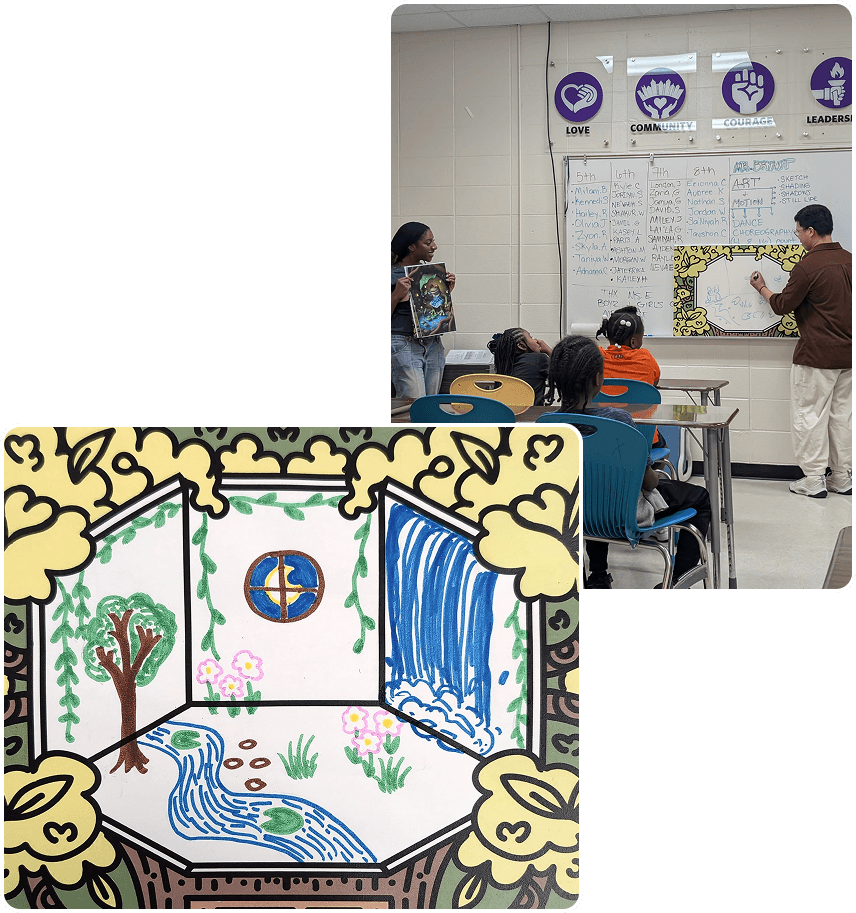
With 9 students at the Boys & Girls Club of Metro Atlanta and 30 kids and families visiting the Georgia Aquarium. We knew we couldn't design for children without designing with them, so I created a drawing based activity where kids got to design their own tree house.
This allowed us to learn more about their mental models of tree houses as well as identify what concepts about trees and arboreal animals they're already familiar with.
I REDESIGNED
MY DRAWING SHEETS…
After session one to prioritize
structure over coloring, and added a storybook option for children uncomfortable with drawing.
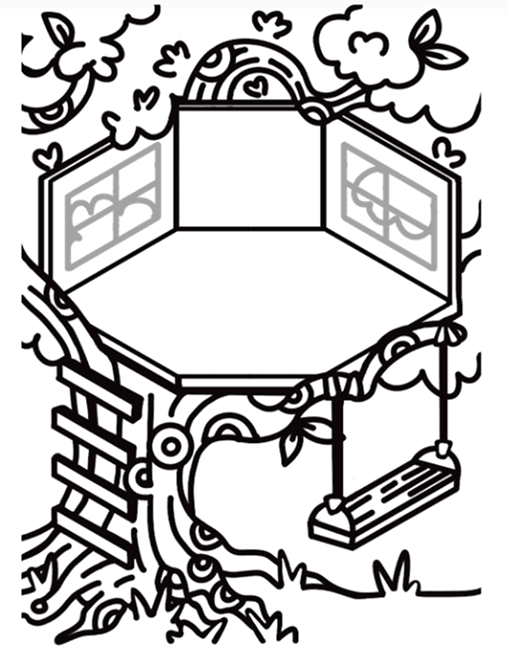
Drawing sheet for Session 1
Drawing sheet for Session 1
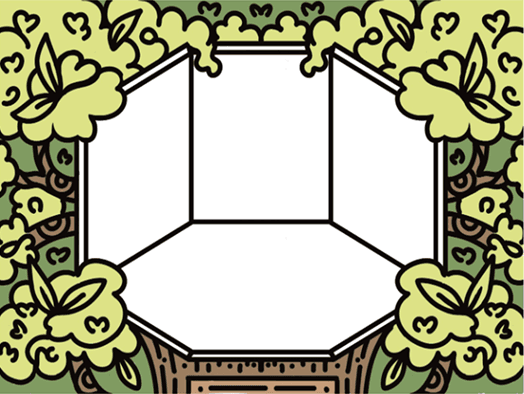
Drawing sheet for Session 2
Drawing sheet for Session 2
key findings & takeaways
The experience must be multimodal and gamified, not text-heavy
Children immediately disengage when an exhibit feels like a classroom. Multisensory inputs and exploration are the strongest drivers of retention.
Designs must incoporate elements of homes and play spaces
Analysis of 42 child-drawn treehouses revealed that kids view them as homes or secret play spaces, not just observation decks.
Navigation must be intuitive and embedded in the play
To avoid bottlenecks in a linear path. We found that repetitive multimodal cues (visual + audio + tactile) kept children moving naturally.
The experience must be multimodal and gamified, not text-heavy
Children immediately disengage when an exhibit feels like a classroom. Multisensory inputs and exploration are the strongest drivers of retention.
Designs must incoporate elements of homes and play spaces
Analysis of 42 child-drawn treehouses revealed that kids view them as homes or secret play spaces, not just observation decks.
Navigation must be intuitive and embedded in the play
To avoid bottlenecks in a linear path. We found that repetitive multimodal cues (visual + audio + tactile) kept children moving naturally.
The experience must be multimodal and gamified, not text-heavy
Children immediately disengage when an exhibit feels like a classroom. Multisensory inputs and exploration are the strongest drivers of retention.
Designs must incoporate elements of homes and play spaces
Analysis of 42 child-drawn treehouses revealed that kids view them as homes or secret play spaces, not just observation decks.
Navigation must be intuitive and embedded in the play
To avoid bottlenecks in a linear path. We found that repetitive multimodal cues (visual + audio + tactile) kept children moving naturally.
Ideation & DEsign
34 Sketches
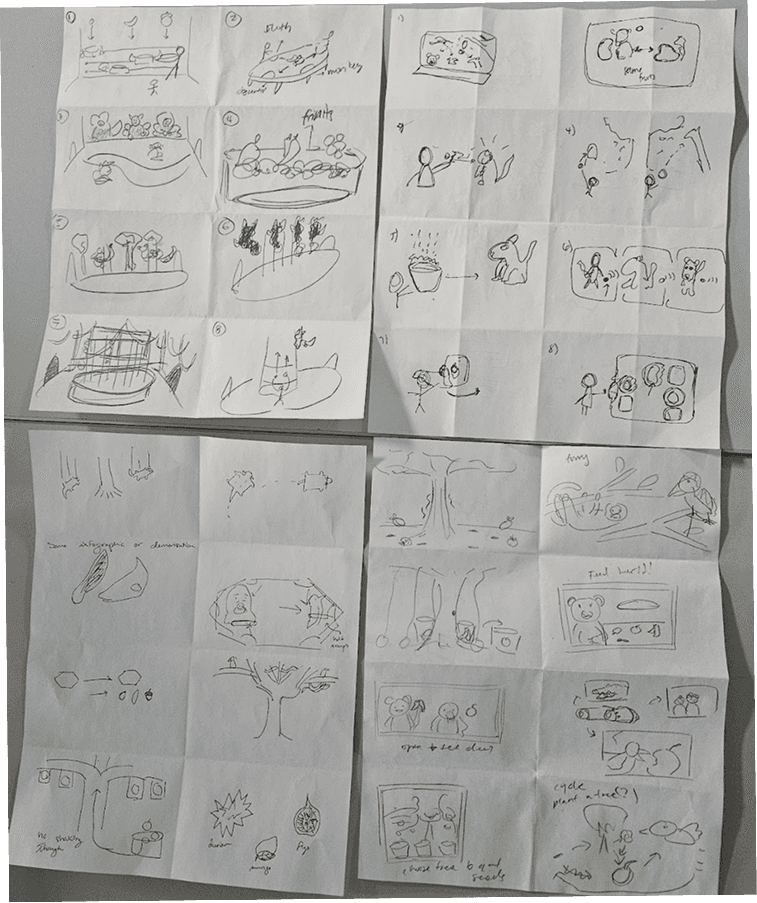
We employed the crazy 8's method to ideate multiple interactives and themese for each of the 4 area in the exhibit.
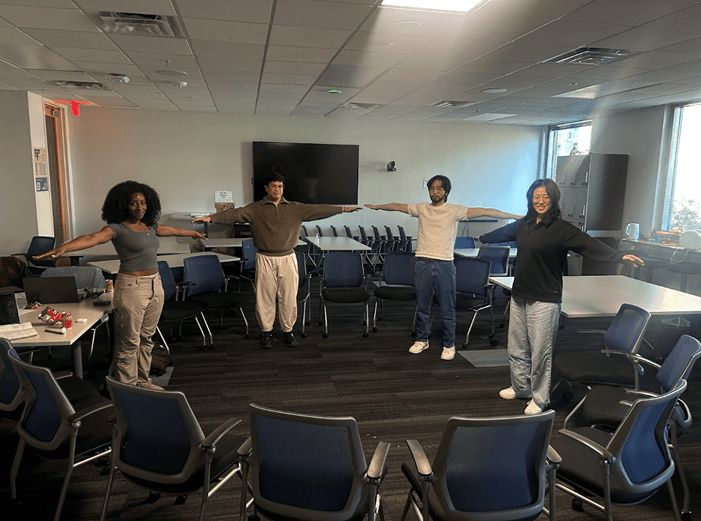
We reconstructed the physical boundaries to ensure our designs were feasible and fit the space.

13 Concepts + main story
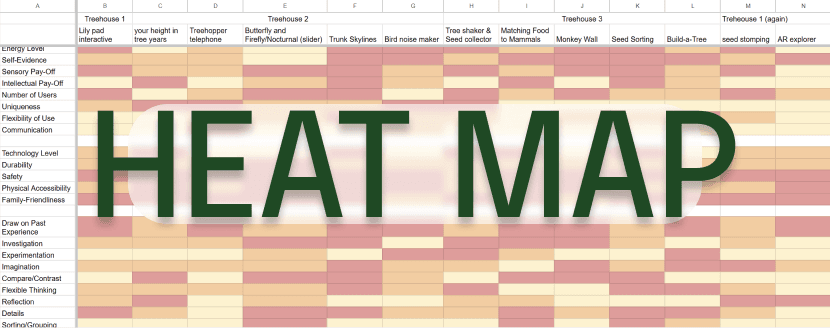
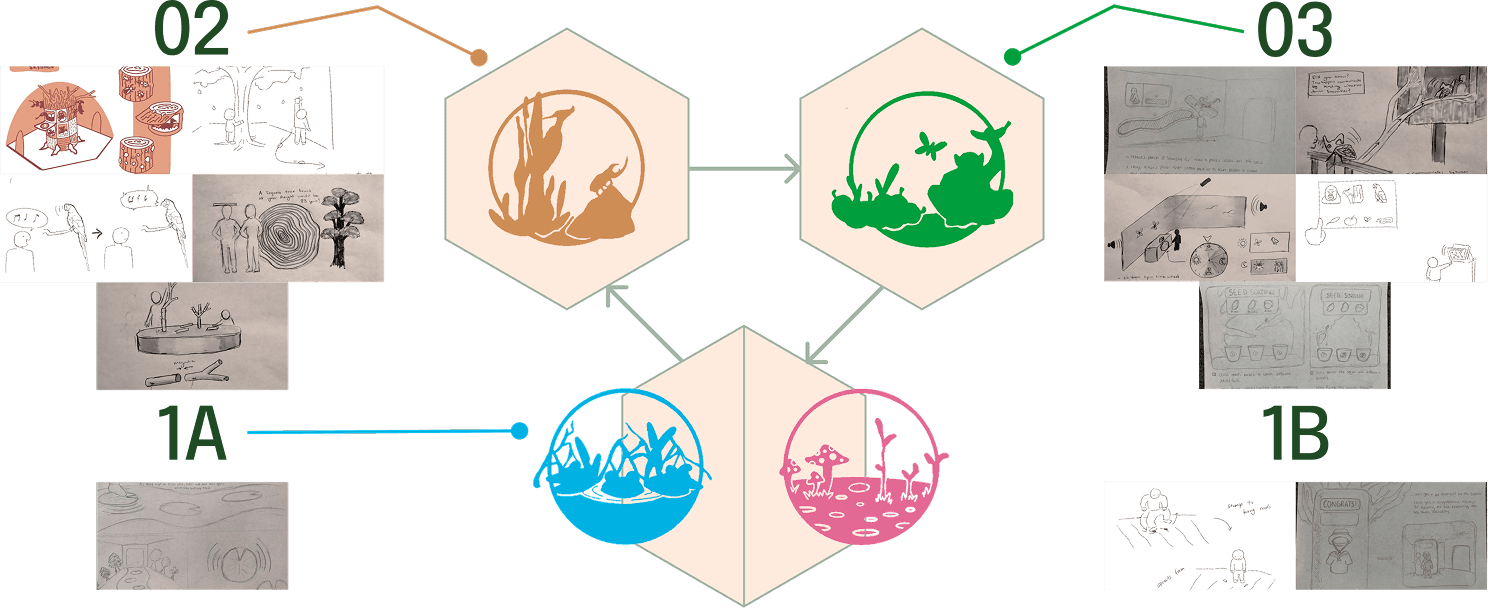
We then used a heuristic heat map to narrow down
our ideas to present to sponsors and SMEs.
heuristic heatmap
We validated our concepts using a
research-driven heatmap, scoring each design
on usability, feasibility, and its ability to foster
critical thinking skills.
feedback #1
With Georgia Aquarium Sponsors & Dr. Heidi Biggs (Ecology SME).
Early concepts were too complex for the 3-5 minute window.
Pivot
We simplified interactions to be immediately intuitive and durable, prioritizing physical immersion over complex digital inputs.
feedback #2
With Julia Forbes (High Museum) & Dr. Roberts (Learning Science SME).
Interactions were unintuitive and limited to single users.
Pivot
We prioritized clear usability cues and parallel play, allowing multiple children to engage simultaneously without bottlenecks.
Accessiblity note
To ensure inclusivity, we designed the experience so that all our concepts could be translated into supplementary ground-floor activities, ensuring children unable to climb into the treehouse still received the full educational narrative.
Final prototypes
wE DESIGNED AND BUILt 5 PHYSICAL PROTOYPES…
Each of the prototypes were built for a specific tree house in the exhibit. They showcase the life cycle of a tree and it's beneficial relationship with arboreal animals, insects and plants as shelter and sources of food.

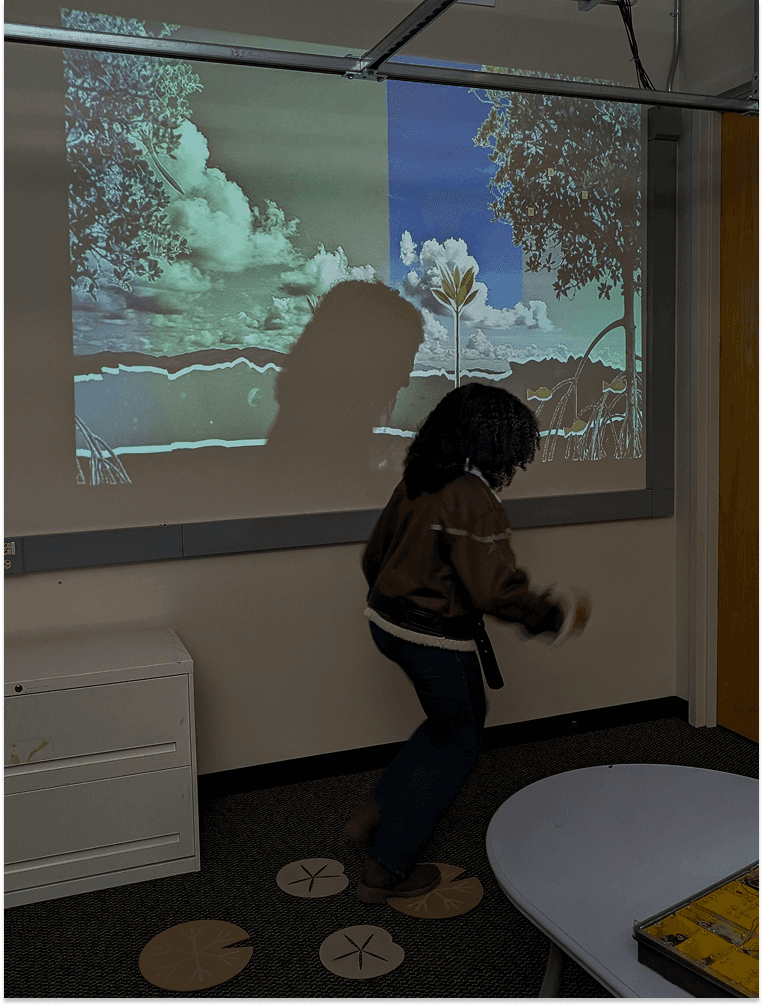
(1) Reactive Lilypad HOPSCOTCH
Floor-based sensors shaped like lilypads trigger a wall display showing the mangrove lifecycle as children step on them.
Problem Solved: Linear Flow
Placed at the entrance, this utilizes a "hop-skip" mechanic to physically propel high-energy children into the room, preventing bottlenecks at the door.
(2) Tree top interactives
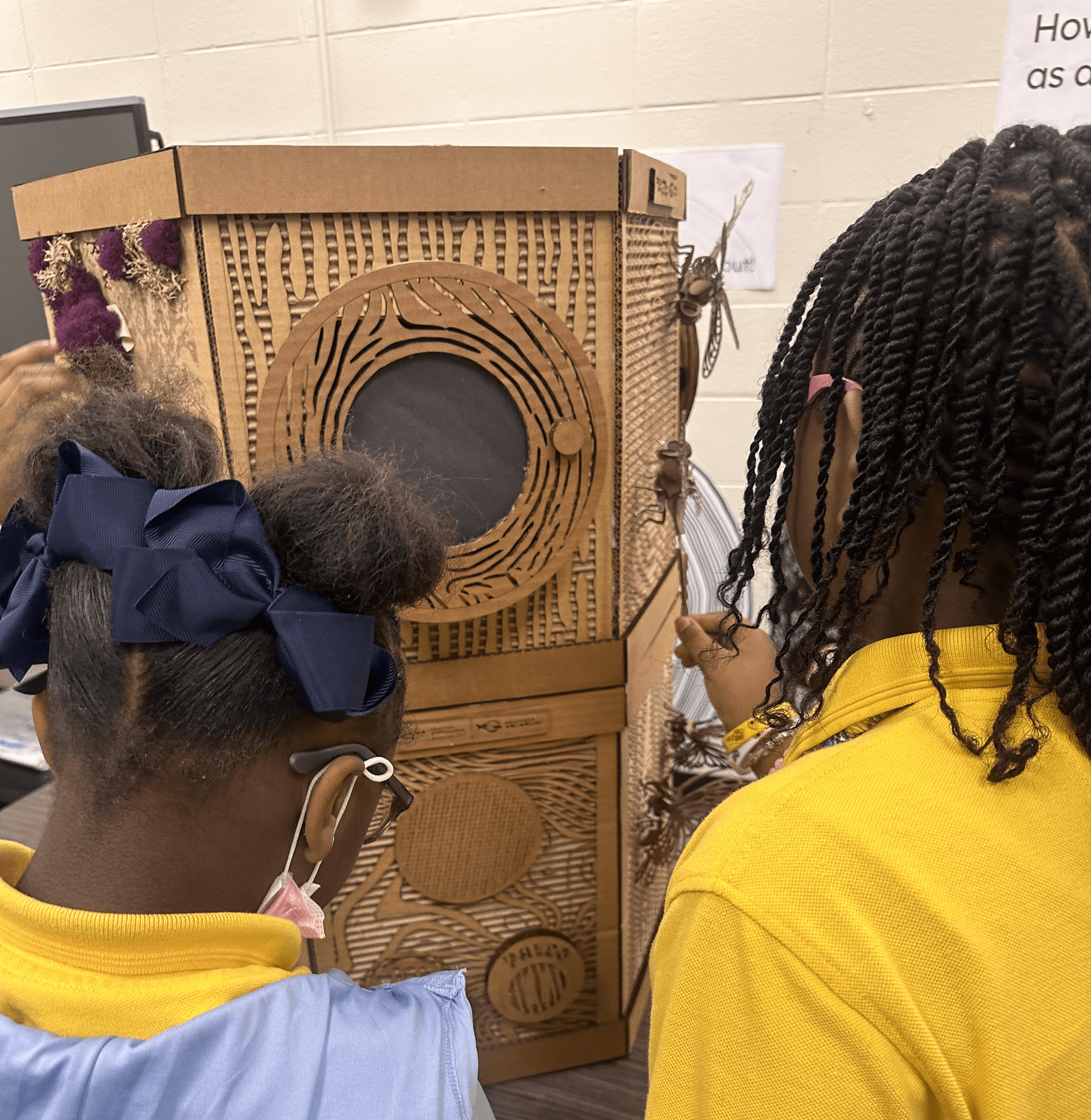
A wrap-around interactive encasing the central support beam, featuring hidden cabinets, varied bark textures, and mini-dioramas of arboreal animals.
Problem Solved: Physical Constraints
We turned the room’s biggest obstruction (the central beam) into its primary exploratory surface, maximizing the 12ft footprint.
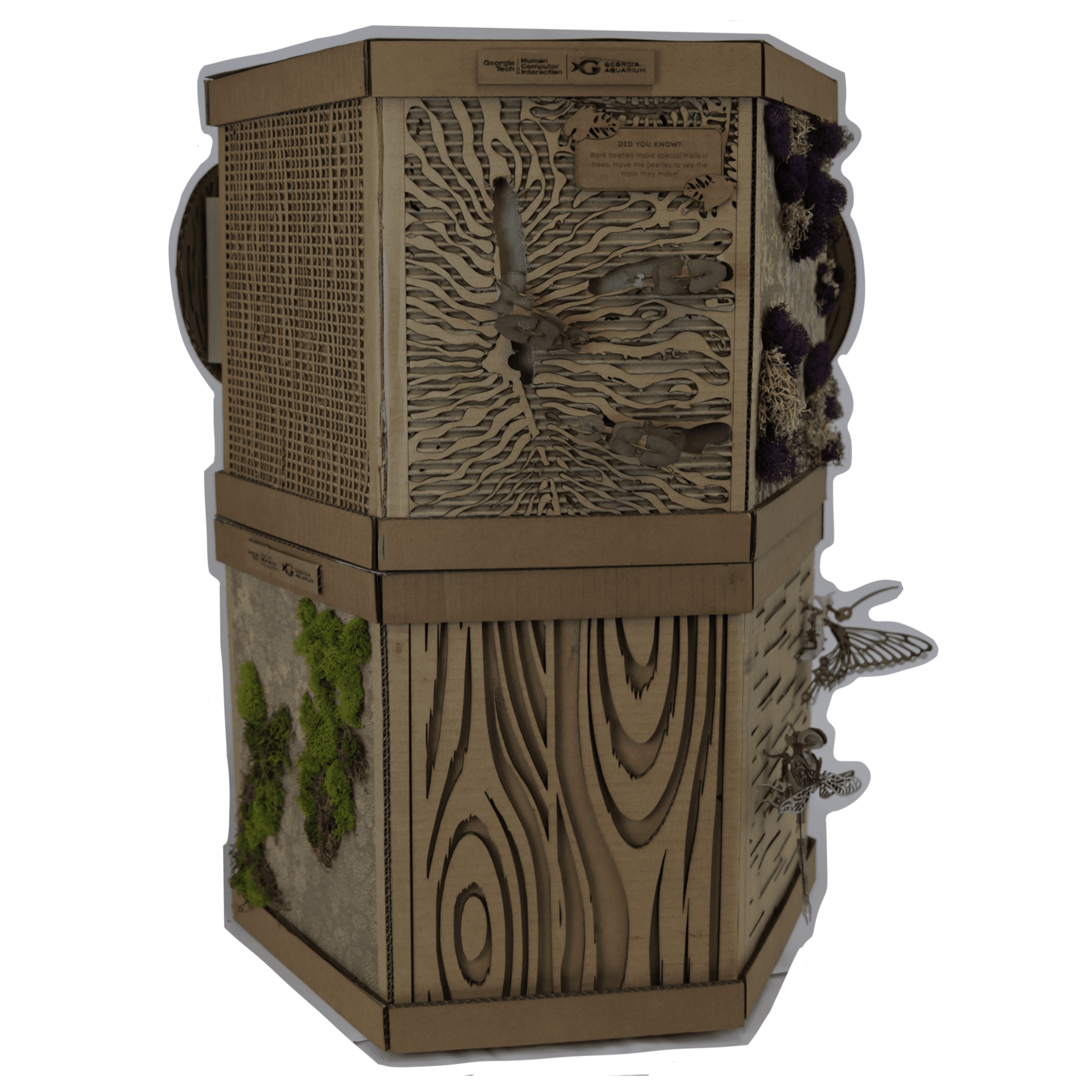
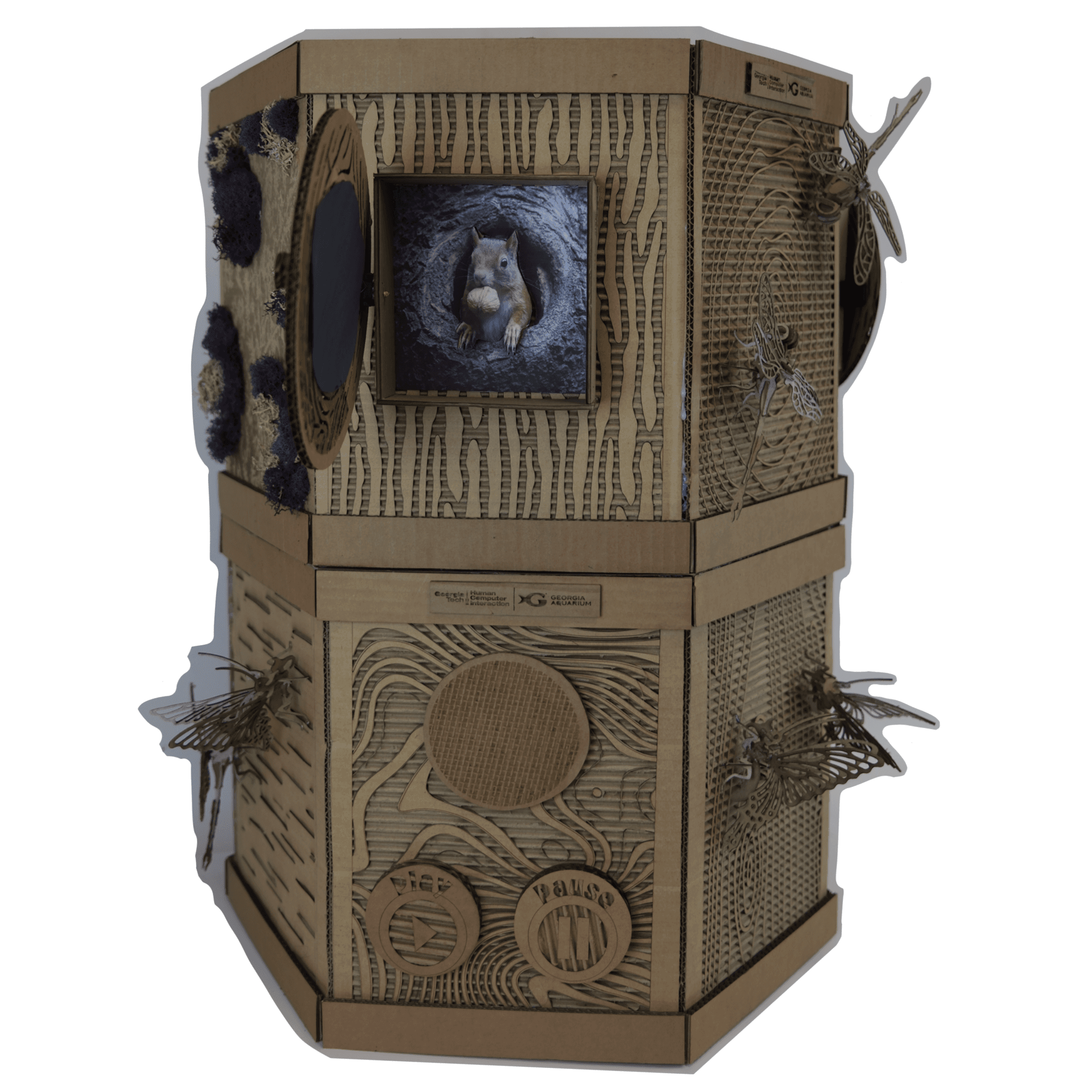
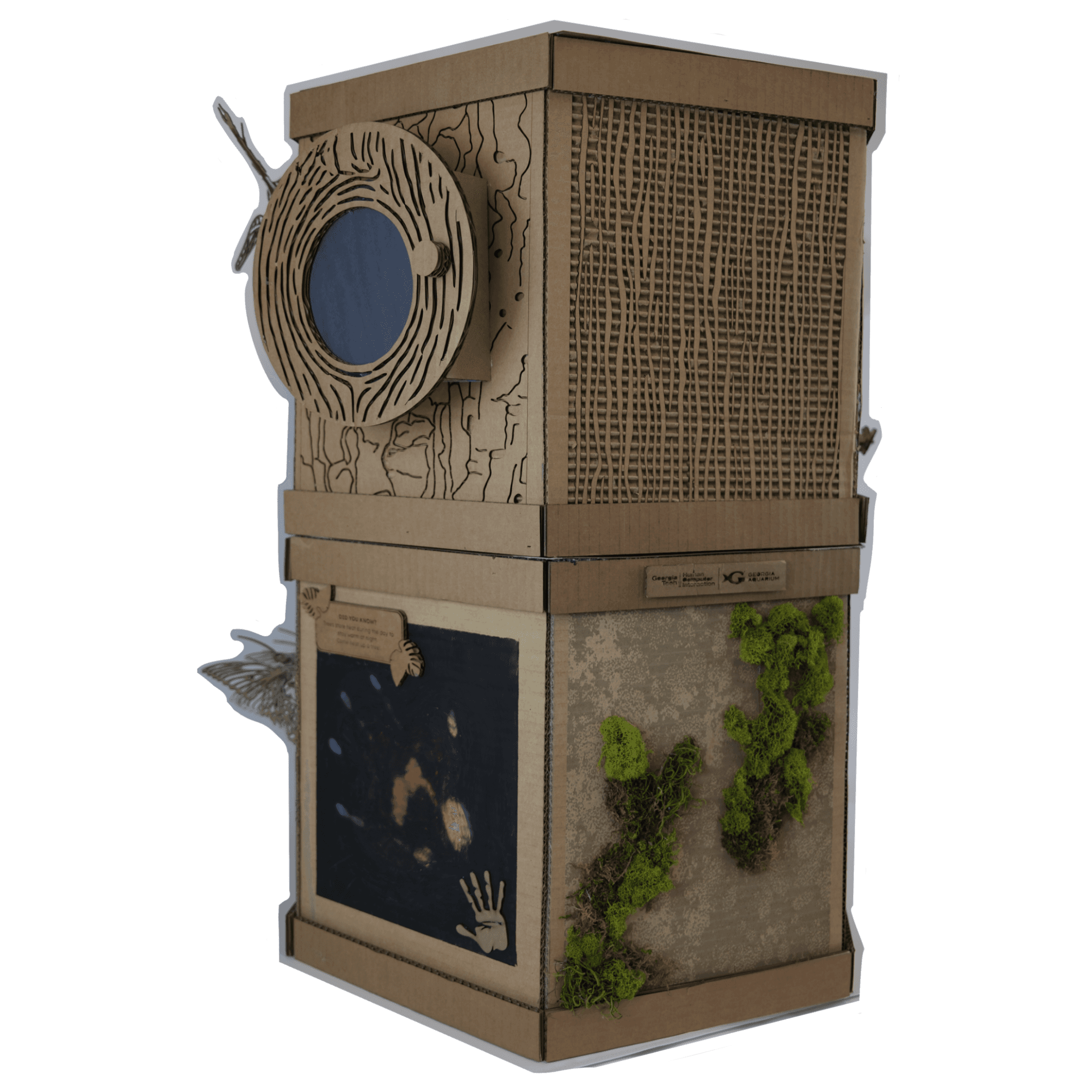
Moveable bugs and hidden doors reveal
relationships between animals and trees
INTERACTIVE ELEMENTS
INTERACTIVE ELEMENTS
Panels of bark samples and moss
shows the biodiversity of trees
and keeps children engaged
TEXTURED PANELS
Multimodal experience for kids to learn
about arboreal animals and trees
Life size models and creative activities like the
heat panels educate and keep children engaged
AUDIO INTERACTIONS
EXPERIENTIAL LEARNING
(3) fruit buttons game
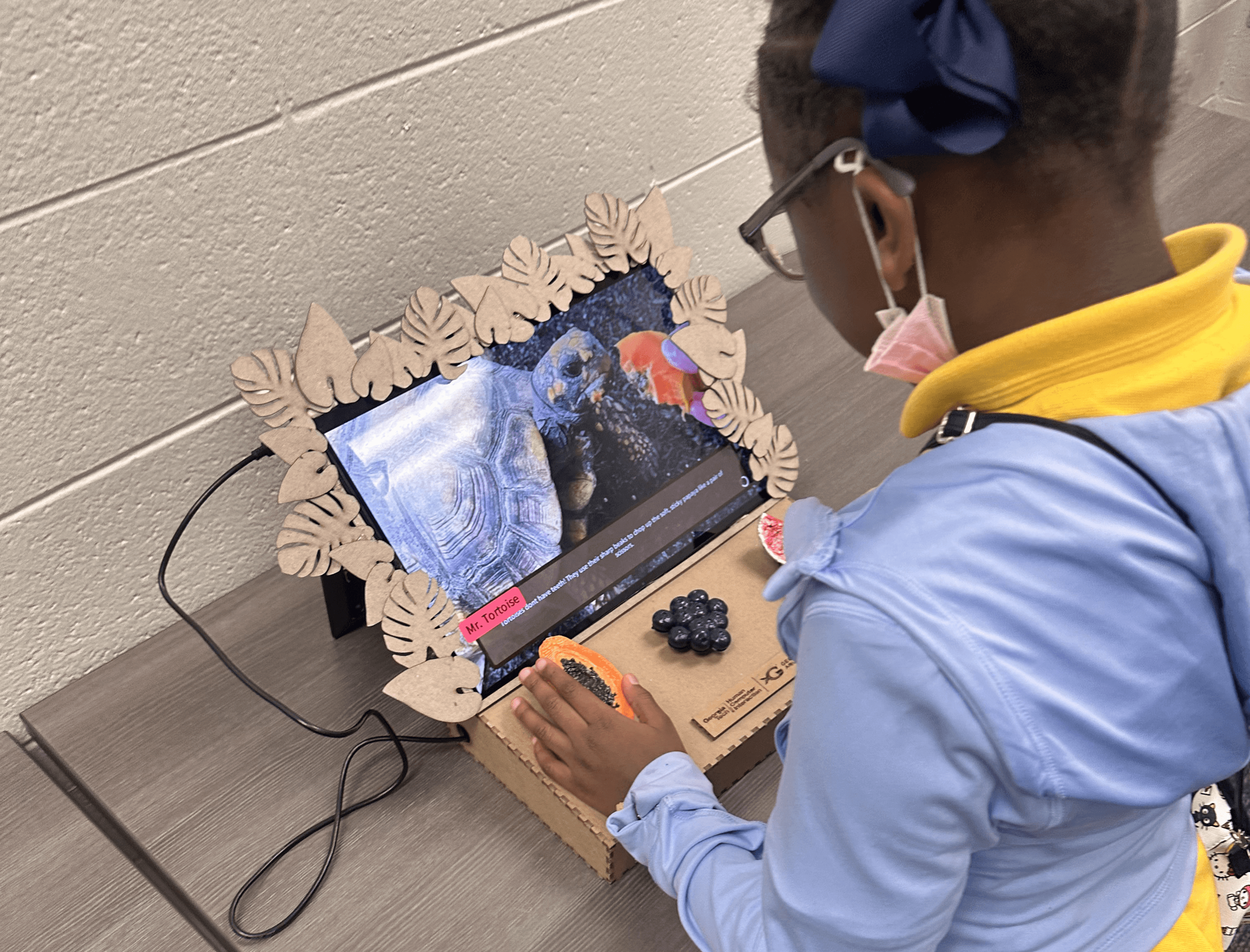
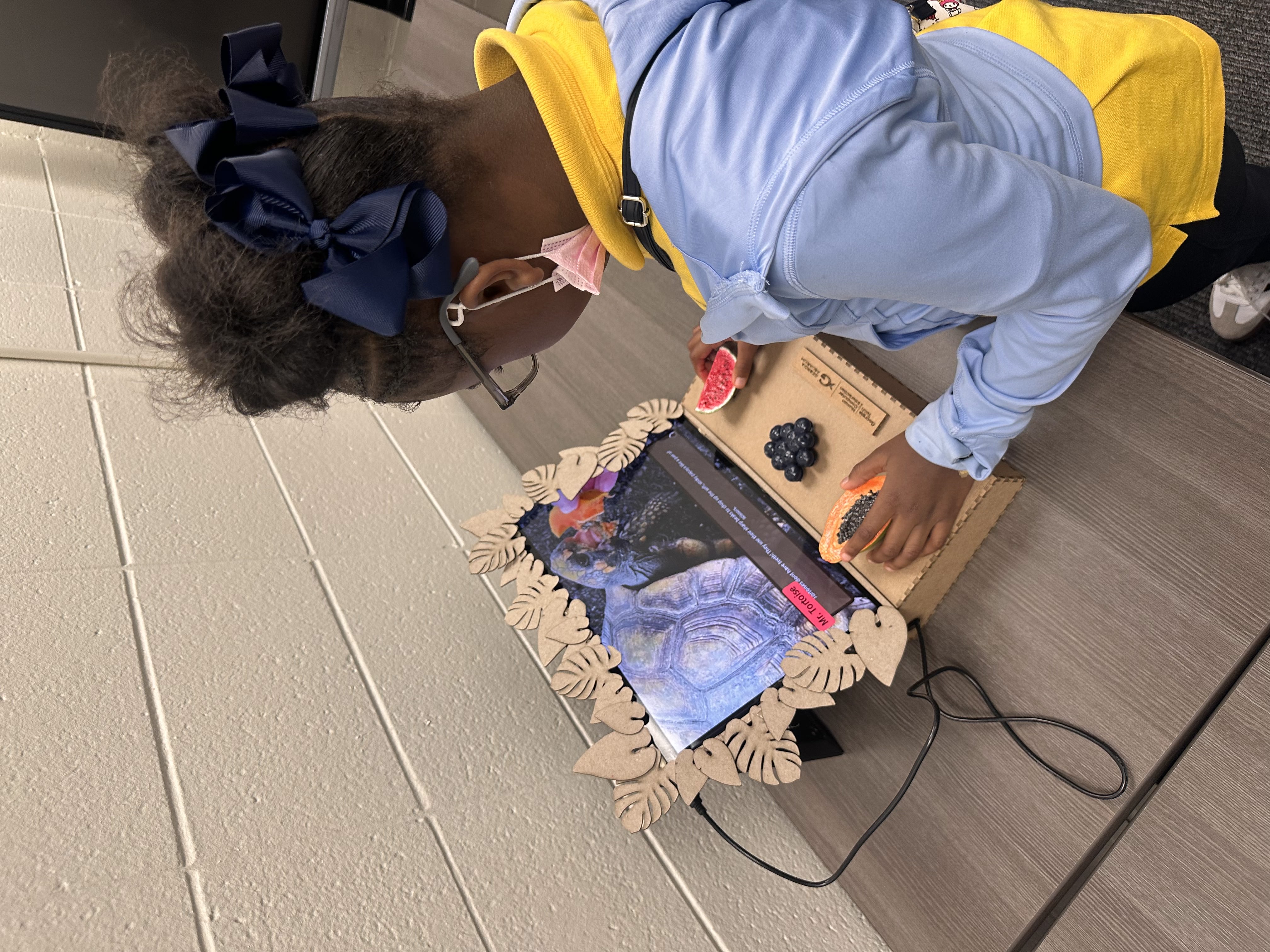
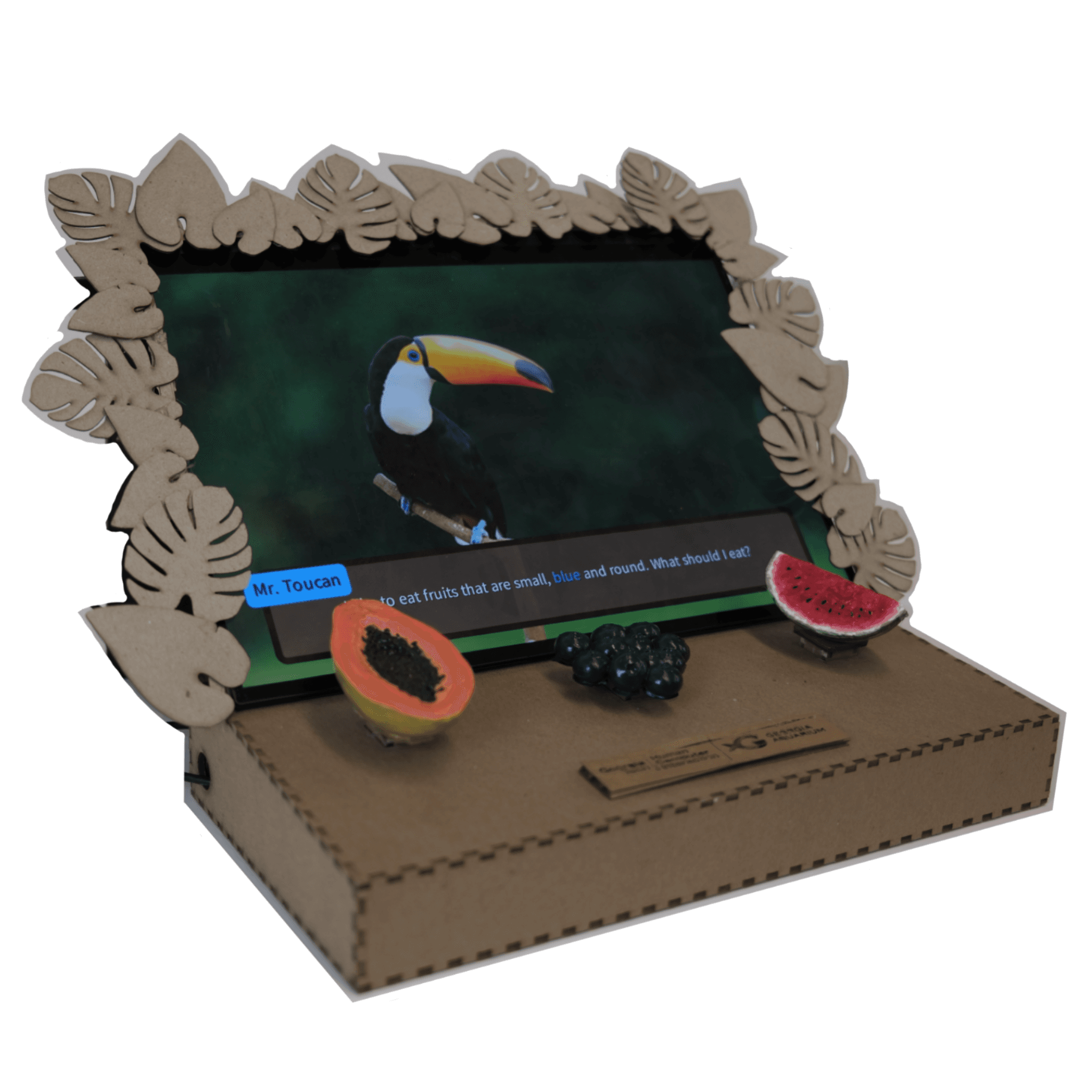
A digital display controlled by life-sized, physical fruit buttons. Children guess an animal's diet; correct guesses trigger a video of the animal eating, while incorrect guesses provide gentle, instant audio correction.
Problem Solved: Usability
Provides the immediate feedback loops children require and a static screen with a tactile, gamified input.
(4) Tree Ring Scale
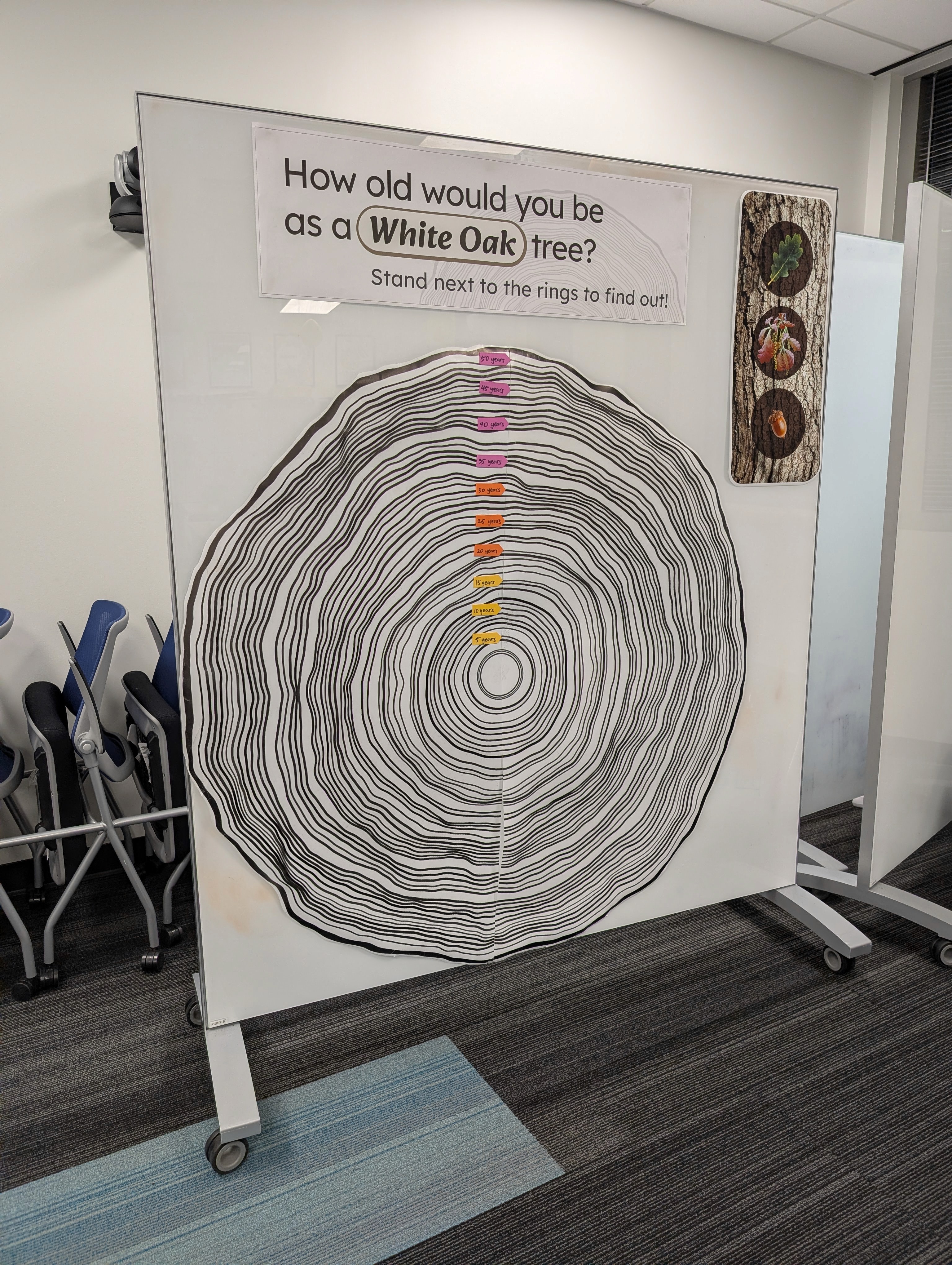
A vertical measure that compares a child’s height to tree rings, estimating their "Tree Age." The sides feature tactile samples of fruit and leaves.
Problem Solved: Social Play
This encourages kids to line up and compare ages, turning a passive reading moment into an active group activity.
(5) Decomposing Log
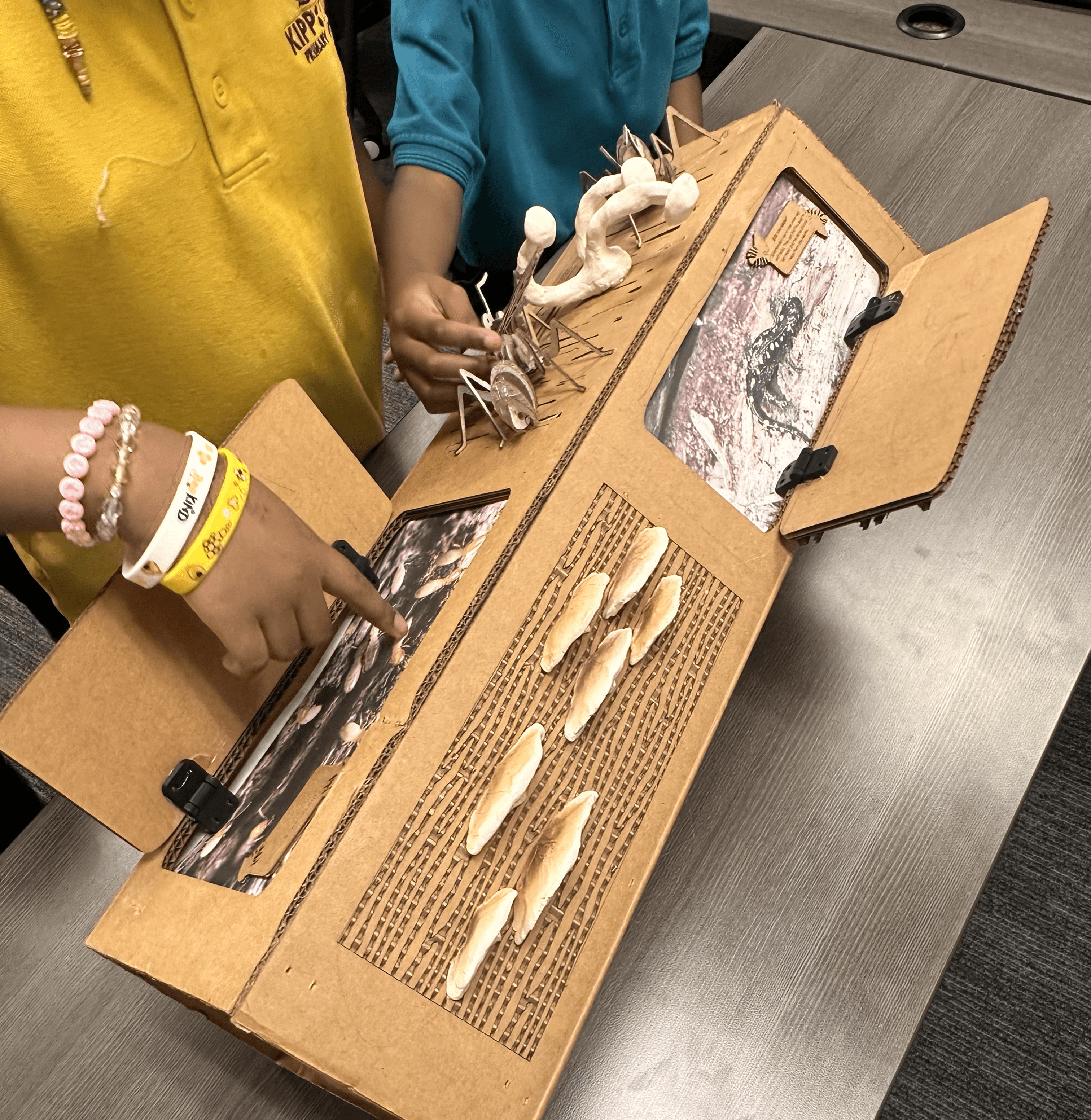
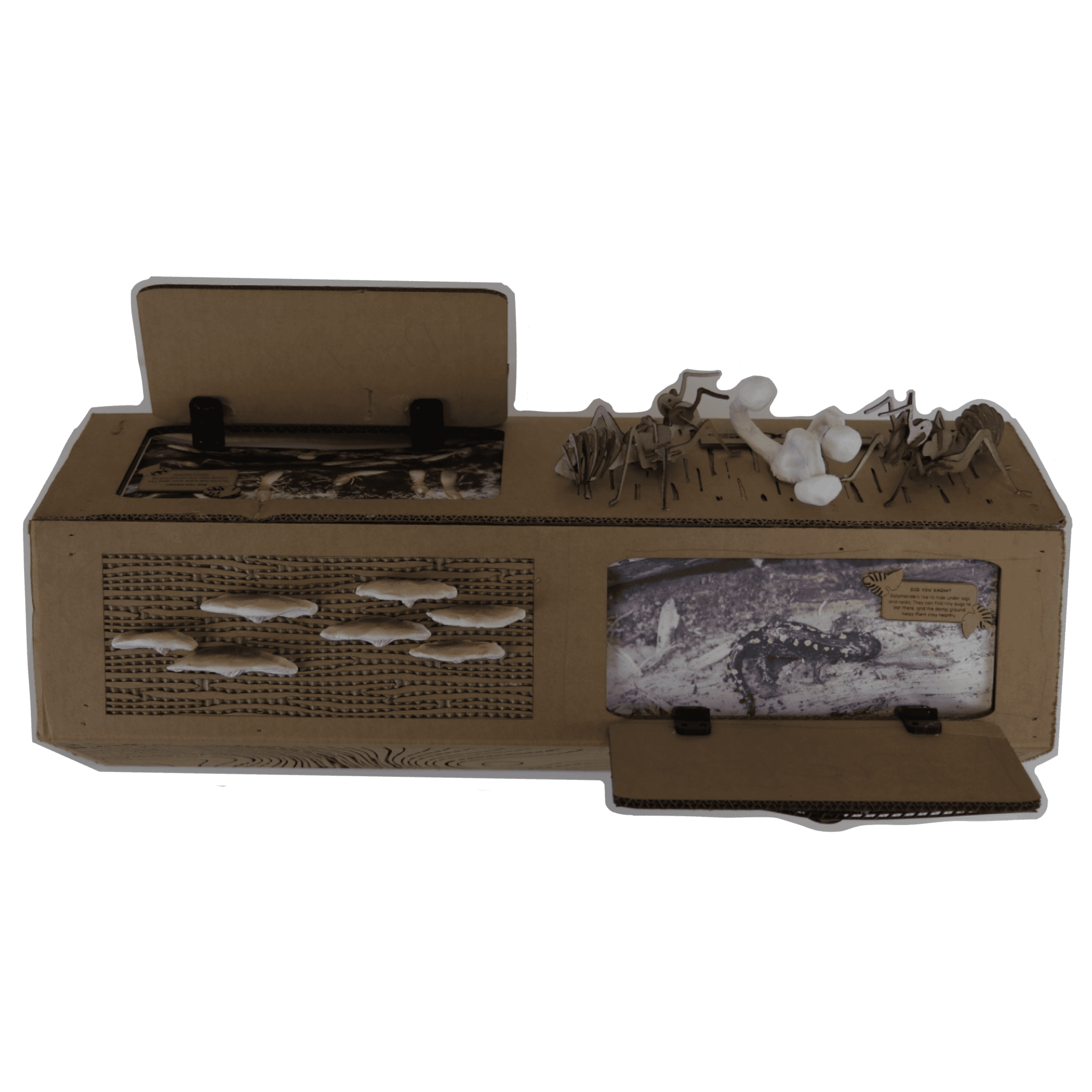
A physical model of a decaying log featuring openable doors revealing mushrooms, termites, and decomposers.
Problem Solved: The Narrative Arc
It visualizes the end of the lifecycle, reinforcing that even in "death," the tree provides for the ecosystem.
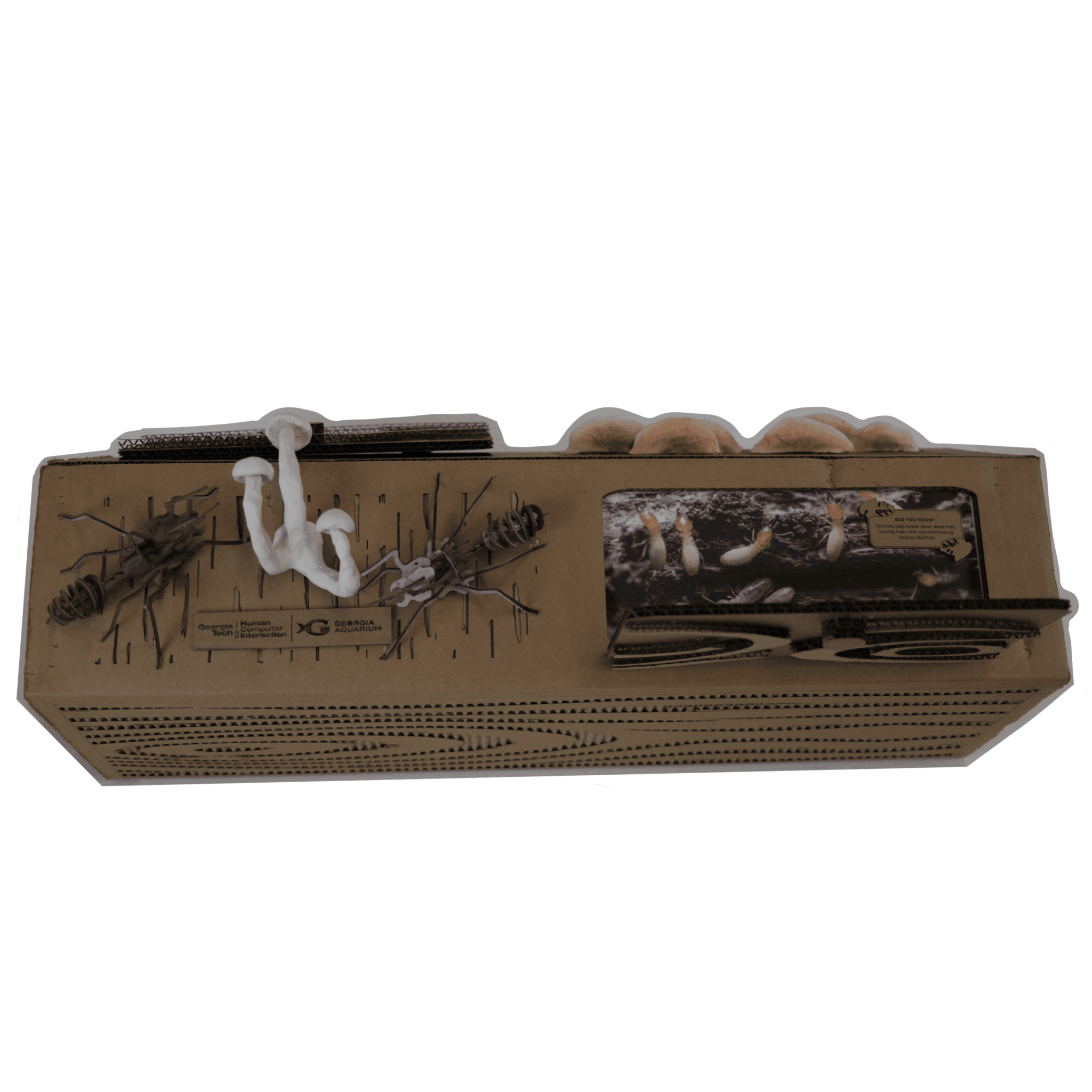
Moveable bugs and hidden doors reveal
relationships between animals and trees
INTERACTIVE ELEMENTS
INTERACTIVE ELEMENTS
Panels of bark samples and mushrooms shows
the biodiversity of trees and keeps children engaged
TEXTURED PANELS
Reflection & Key Takeaways
Over the course of the semester, I navigated the complexities of physical space, child psychology, and stakeholder management.
Designing for Unpredictability
Working with the Boys & Girls Club taught us that success isn't about forcing a child to follow instructions, it's about creating intuitive systems that withstand chaos and high energy while still delivering educational value.
Bridging the Digital-Physical Gap
With limited industrial design experience, our team had to rapidly upskill. We moved beyond screens to prototype tactile, physical artifacts, learning more about UX and interaction design.
Navigating Constraints & Ambiguity
This project had no clear roadmap—just a 12ft circle and a support beam. We constantly learned from user and stakeholder feedback to turn abstract constraints into a concrete, cohesive narrative.
Designing for Unpredictability
Working with the Boys & Girls Club taught us that success isn't about forcing a child to follow instructions, it's about creating intuitive systems that withstand chaos and high energy while still delivering educational value.
Bridging the Digital-Physical Gap
With limited industrial design experience, our team had to rapidly upskill. We moved beyond screens to prototype tactile, physical artifacts, learning more about UX and interaction design.
Navigating Constraints & Ambiguity
This project had no clear roadmap—just a 12ft circle and a support beam. We constantly learned from user and stakeholder feedback to turn abstract constraints into a concrete, cohesive narrative.
Designing for Unpredictability
Working with the Boys & Girls Club taught us that success isn't about forcing a child to follow instructions, it's about creating intuitive systems that withstand chaos and high energy while still delivering educational value.
Bridging the Digital-Physical Gap
With limited industrial design experience, our team had to rapidly upskill. We moved beyond screens to prototype tactile, physical artifacts, learning more about UX and interaction design.
Navigating Constraints & Ambiguity
This project had no clear roadmap—just a 12ft circle and a support beam. We constantly learned from user and stakeholder feedback to turn abstract constraints into a concrete, cohesive narrative.
Sponsored Project
Research
Design
canopy walk
Team :
Chielota Uma, Johnny Nguyen, Cathy Lin
Final Deliverable :
5 Educational Interactive Prototypes
Project Duration :
Aug 2025 -> Dec 2025 | 17 Weeks
Methodology :
Co-Design, Iterative Testing, Physical Prototyping
At a Glance
How can immersive design thrive within physical limits?
The Georgia Aquarium is expanding the Peterson Freshwater Preserve with Canopy Walk, a new exhibit connecting three treehouses via rope bridges. Our task was to design an engaging ecosystem experience for children (ages 5-8) that manages high crowd flow and utilized space efficiently.
So we designed a four-stage user journey that guides children through the tree life cycle and ecosystem dynamics. The experience integrates five hybrid digital-physical touchpoints, each gamifying specific educational concepts to increase engagement and retention.
research & discovery
contextual & Physical Analysis
The Canopy walk will have 3 different tree house themed play areas for children to learn and explore the tree canopy system. The exhibit structure presents three main constraints in our project:
Diagram from Georgia Aquarium
The first house is bisected with
separate entry and exit points,
requiring a strict one-way linear flow.
NO BACKTRACKING
NO BACKTRACKING
Interactions must conclude within
a 3-5 minute window to avoid
overcrowding.
TIME PRESSURE
Each treehouse has a 12ft diameter
and a central support beam.
LIMITED SPACE
conducting MIXed METHODs
To understand how to thoughtfully design accessible interactive exhibits for children and how what makes an interaction fun, accessible & educational.
5
LIT REVIEWS
13
INTERVIEWS
7
OBSERVATION
SITES
70
SURVEY
RESPONSES
42
CO-DESIGN
DRAWINGS
mY main ROLE IN THIS PHASE…
was to analyze research papers, collect surveys, engage in ethnographic observations, and conduct interviews.
i lead 2 co-design sessions…
With 9 students at the Boys & Girls Club of Metro Atlanta and 30 kids and families visiting the Georgia Aquarium. We knew we couldn't design for children without designing with them, so I created a drawing based activity where kids got to design their own tree house.
This allowed us to learn more about their mental models of tree houses as well as identify what concepts about trees and arboreal animals they're already familiar with.
I REDESIGNED
MY DRAWING SHEETS…
After session one to prioritize
structure over coloring, and added a storybook option for children uncomfortable with drawing.
Drawing sheet for Session 1
Drawing sheet for Session 1
Drawing sheet for Session 2
Drawing sheet for Session 2
key findings & takeaways
The experience must be multimodal and gamified, not text-heavy
Children immediately disengage when an exhibit feels like a classroom. Multisensory inputs and exploration are the strongest drivers of retention.
Designs must incoporate elements of homes and play spaces
Analysis of 42 child-drawn treehouses revealed that kids view them as homes or secret play spaces, not just observation decks.
Navigation must be intuitive and embedded in the play
To avoid bottlenecks in a linear path. We found that repetitive multimodal cues (visual + audio + tactile) kept children moving naturally.
The experience must be multimodal and gamified, not text-heavy
Children immediately disengage when an exhibit feels like a classroom. Multisensory inputs and exploration are the strongest drivers of retention.
Designs must incoporate elements of homes and play spaces
Analysis of 42 child-drawn treehouses revealed that kids view them as homes or secret play spaces, not just observation decks.
Navigation must be intuitive and embedded in the play
To avoid bottlenecks in a linear path. We found that repetitive multimodal cues (visual + audio + tactile) kept children moving naturally.
The experience must be multimodal and gamified, not text-heavy
Children immediately disengage when an exhibit feels like a classroom. Multisensory inputs and exploration are the strongest drivers of retention.
Designs must incoporate elements of homes and play spaces
Analysis of 42 child-drawn treehouses revealed that kids view them as homes or secret play spaces, not just observation decks.
Navigation must be intuitive and embedded in the play
To avoid bottlenecks in a linear path. We found that repetitive multimodal cues (visual + audio + tactile) kept children moving naturally.
Ideation & DEsign
34 Sketches
We employed the crazy 8's method to ideate multiple interactives and themese for each of the 4 area in the exhibit.
We reconstructed the physical boundaries to ensure our designs were feasible and fit the space.
13 Concepts + main story
We then used a heuristic heat map to narrow down
our ideas to present to sponsors and SMEs.
heuristic heatmap
We validated our concepts using a
research-driven heatmap, scoring each design
on usability, feasibility, and its ability to foster
critical thinking skills.
feedback #1
With Georgia Aquarium Sponsors & Dr. Heidi Biggs (Ecology SME).
Early concepts were too complex for the 3-5 minute window.
Pivot
We simplified interactions to be immediately intuitive and durable, prioritizing physical immersion over complex digital inputs.
feedback #2
With Julia Forbes (High Museum) & Dr. Roberts (Learning Science SME).
Interactions were unintuitive and limited to single users.
Pivot
We prioritized clear usability cues and parallel play, allowing multiple children to engage simultaneously without bottlenecks.
Accessiblity note
To ensure inclusivity, we designed the experience so that all our concepts could be translated into supplementary ground-floor activities, ensuring children unable to climb into the treehouse still received the full educational narrative.
Final prototypes
wE DESIGNED AND BUILt 5 PHYSICAL PROTOYPES…
Each of the prototypes were built for a specific tree house in the exhibit. They showcase the life cycle of a tree and it's beneficial relationship with arboreal animals, insects and plants as shelter and sources of food.
(1) Reactive Lilypad HOPSCOTCH
Floor-based sensors shaped like lilypads trigger a wall display showing the mangrove lifecycle as children step on them.
Problem Solved: Linear Flow
Placed at the entrance, this utilizes a "hop-skip" mechanic to physically propel high-energy children into the room, preventing bottlenecks at the door.
(2) Tree top interactives
A wrap-around interactive encasing the central support beam, featuring hidden cabinets, varied bark textures, and mini-dioramas of arboreal animals.
Problem Solved: Physical Constraints
We turned the room’s biggest obstruction (the central beam) into its primary exploratory surface, maximizing the 12ft footprint.
Moveable bugs and hidden doors reveal
relationships between animals and trees
INTERACTIVE ELEMENTS
INTERACTIVE ELEMENTS
Panels of bark samples and moss
shows the biodiversity of trees
and keeps children engaged
TEXTURED PANELS
Multimodal experience for kids to learn
about arboreal animals and trees
Life size models and creative activities like the
heat panels educate and keep children engaged
AUDIO INTERACTIONS
EXPERIENTIAL LEARNING
(3) fruit buttons game
A digital display controlled by life-sized, physical fruit buttons. Children guess an animal's diet; correct guesses trigger a video of the animal eating, while incorrect guesses provide gentle, instant audio correction.
Problem Solved: Usability
Provides the immediate feedback loops children require and a static screen with a tactile, gamified input.
(4) Tree Ring Scale
A vertical measure that compares a child’s height to tree rings, estimating their "Tree Age." The sides feature tactile samples of fruit and leaves.
Problem Solved: Social Play
This encourages kids to line up and compare ages, turning a passive reading moment into an active group activity.
(5) Decomposing Log
A physical model of a decaying log featuring openable doors revealing mushrooms, termites, and decomposers.
Problem Solved: The Narrative Arc
It visualizes the end of the lifecycle, reinforcing that even in "death," the tree provides for the ecosystem.
Moveable bugs and hidden doors reveal
relationships between animals and trees
INTERACTIVE ELEMENTS
INTERACTIVE ELEMENTS
Panels of bark samples and mushrooms shows
the biodiversity of trees and keeps children engaged
TEXTURED PANELS
Reflection & Key Takeaways
Over the course of the semester, I navigated the complexities of physical space, child psychology, and stakeholder management.
Designing for Unpredictability
Working with the Boys & Girls Club taught us that success isn't about forcing a child to follow instructions, it's about creating intuitive systems that withstand chaos and high energy while still delivering educational value.
Bridging the Digital-Physical Gap
With limited industrial design experience, our team had to rapidly upskill. We moved beyond screens to prototype tactile, physical artifacts, learning more about UX and interaction design.
Navigating Constraints & Ambiguity
This project had no clear roadmap—just a 12ft circle and a support beam. We constantly learned from user and stakeholder feedback to turn abstract constraints into a concrete, cohesive narrative.
Designing for Unpredictability
Working with the Boys & Girls Club taught us that success isn't about forcing a child to follow instructions, it's about creating intuitive systems that withstand chaos and high energy while still delivering educational value.
Bridging the Digital-Physical Gap
With limited industrial design experience, our team had to rapidly upskill. We moved beyond screens to prototype tactile, physical artifacts, learning more about UX and interaction design.
Navigating Constraints & Ambiguity
This project had no clear roadmap—just a 12ft circle and a support beam. We constantly learned from user and stakeholder feedback to turn abstract constraints into a concrete, cohesive narrative.
Designing for Unpredictability
Working with the Boys & Girls Club taught us that success isn't about forcing a child to follow instructions, it's about creating intuitive systems that withstand chaos and high energy while still delivering educational value.
Bridging the Digital-Physical Gap
With limited industrial design experience, our team had to rapidly upskill. We moved beyond screens to prototype tactile, physical artifacts, learning more about UX and interaction design.
Navigating Constraints & Ambiguity
This project had no clear roadmap—just a 12ft circle and a support beam. We constantly learned from user and stakeholder feedback to turn abstract constraints into a concrete, cohesive narrative.
Sponsored Project
Research
Design
canopy walk
Team :
Chielota Uma, Johnny Nguyen, Cathy Lin
Final Deliverable :
5 Educational Interactive Prototypes
Project Duration :
Aug 2025 -> Dec 2025 | 17 Weeks
Methodology :
Co-Design, Iterative Testing, Physical Prototyping
At a Glance
How can immersive design thrive within physical limits?
The Georgia Aquarium is expanding the Peterson Freshwater Preserve with Canopy Walk, a new exhibit connecting three treehouses via rope bridges. Our task was to design an engaging ecosystem experience for children (ages 5-8) that manages high crowd flow and utilized space efficiently.
So we designed a four-stage user journey that guides children through the tree life cycle and ecosystem dynamics. The experience integrates five hybrid digital-physical touchpoints, each gamifying specific educational concepts to increase engagement and retention.
research & discovery
contextual & Physical Analysis
The Canopy walk will have 3 different tree house themed play areas for children to learn and explore the tree canopy system. The exhibit structure presents three main constraints in our project:
Diagram from Georgia Aquarium
The first house is bisected with
separate entry and exit points,
requiring a strict one-way linear flow.
NO BACKTRACKING
NO BACKTRACKING
Interactions must conclude within
a 3-5 minute window to avoid
overcrowding.
TIME PRESSURE
Each treehouse has a 12ft diameter
and a central support beam.
LIMITED SPACE
conducting MIXed METHODs
To understand how to thoughtfully design accessible interactive exhibits for children and how what makes an interaction fun, accessible & educational.
5
LIT REVIEWS
13
INTERVIEWS
7
OBSERVATION
SITES
70
SURVEY
RESPONSES
42
CO-DESIGN
DRAWINGS
mY main ROLE IN THIS PHASE…
was to analyze research papers, collect surveys, engage in ethnographic observations, and conduct interviews.
i lead 2 co-design sessions…
With 9 students at the Boys & Girls Club of Metro Atlanta and 30 kids and families visiting the Georgia Aquarium. We knew we couldn't design for children without designing with them, so I created a drawing based activity where kids got to design their own tree house.
This allowed us to learn more about their mental models of tree houses as well as identify what concepts about trees and arboreal animals they're already familiar with.
I REDESIGNED
MY DRAWING SHEETS…
After session one to prioritize
structure over coloring, and added a storybook option for children uncomfortable with drawing.
Drawing sheet for Session 1
Drawing sheet for Session 1
Drawing sheet for Session 2
Drawing sheet for Session 2
key findings & takeaways
The experience must be multimodal and gamified, not text-heavy
Children immediately disengage when an exhibit feels like a classroom. Multisensory inputs and exploration are the strongest drivers of retention.
Designs must incoporate elements of homes and play spaces
Analysis of 42 child-drawn treehouses revealed that kids view them as homes or secret play spaces, not just observation decks.
Navigation must be intuitive and embedded in the play
To avoid bottlenecks in a linear path. We found that repetitive multimodal cues (visual + audio + tactile) kept children moving naturally.
The experience must be multimodal and gamified, not text-heavy
Children immediately disengage when an exhibit feels like a classroom. Multisensory inputs and exploration are the strongest drivers of retention.
Designs must incoporate elements of homes and play spaces
Analysis of 42 child-drawn treehouses revealed that kids view them as homes or secret play spaces, not just observation decks.
Navigation must be intuitive and embedded in the play
To avoid bottlenecks in a linear path. We found that repetitive multimodal cues (visual + audio + tactile) kept children moving naturally.
The experience must be multimodal and gamified, not text-heavy
Children immediately disengage when an exhibit feels like a classroom. Multisensory inputs and exploration are the strongest drivers of retention.
Designs must incoporate elements of homes and play spaces
Analysis of 42 child-drawn treehouses revealed that kids view them as homes or secret play spaces, not just observation decks.
Navigation must be intuitive and embedded in the play
To avoid bottlenecks in a linear path. We found that repetitive multimodal cues (visual + audio + tactile) kept children moving naturally.
Ideation & DEsign
34 Sketches
We employed the crazy 8's method to ideate multiple interactives and themese for each of the 4 area in the exhibit.
We reconstructed the physical boundaries to ensure our designs were feasible and fit the space.
13 Concepts + main story
We then used a heuristic heat map to narrow down
our ideas to present to sponsors and SMEs.
heuristic heatmap
We validated our concepts using a
research-driven heatmap, scoring each design
on usability, feasibility, and its ability to foster
critical thinking skills.
feedback #1
With Georgia Aquarium Sponsors & Dr. Heidi Biggs (Ecology SME).
Early concepts were too complex for the 3-5 minute window.
Pivot
We simplified interactions to be immediately intuitive and durable, prioritizing physical immersion over complex digital inputs.
feedback #2
With Julia Forbes (High Museum) & Dr. Roberts (Learning Science SME).
Interactions were unintuitive and limited to single users.
Pivot
We prioritized clear usability cues and parallel play, allowing multiple children to engage simultaneously without bottlenecks.
Accessiblity note
To ensure inclusivity, we designed the experience so that all our concepts could be translated into supplementary ground-floor activities, ensuring children unable to climb into the treehouse still received the full educational narrative.
Final prototypes
wE DESIGNED AND BUILt 5 PHYSICAL PROTOYPES…
Each of the prototypes were built for a specific tree house in the exhibit. They showcase the life cycle of a tree and it's beneficial relationship with arboreal animals, insects and plants as shelter and sources of food.
(1) Reactive Lilypad HOPSCOTCH
Floor-based sensors shaped like lilypads trigger a wall display showing the mangrove lifecycle as children step on them.
Problem Solved: Linear Flow
Placed at the entrance, this utilizes a "hop-skip" mechanic to physically propel high-energy children into the room, preventing bottlenecks at the door.
(2) Tree top interactives
A wrap-around interactive encasing the central support beam, featuring hidden cabinets, varied bark textures, and mini-dioramas of arboreal animals.
Problem Solved: Physical Constraints
We turned the room’s biggest obstruction (the central beam) into its primary exploratory surface, maximizing the 12ft footprint.
Moveable bugs and hidden doors reveal
relationships between animals and trees
INTERACTIVE ELEMENTS
INTERACTIVE ELEMENTS
Panels of bark samples and moss
shows the biodiversity of trees
and keeps children engaged
TEXTURED PANELS
Multimodal experience for kids to learn
about arboreal animals and trees
Life size models and creative activities like the
heat panels educate and keep children engaged
AUDIO INTERACTIONS
EXPERIENTIAL LEARNING
(3) fruit buttons game
A digital display controlled by life-sized, physical fruit buttons. Children guess an animal's diet; correct guesses trigger a video of the animal eating, while incorrect guesses provide gentle, instant audio correction.
Problem Solved: Usability
Provides the immediate feedback loops children require and a static screen with a tactile, gamified input.
(4) Tree Ring Scale
A vertical measure that compares a child’s height to tree rings, estimating their "Tree Age." The sides feature tactile samples of fruit and leaves.
Problem Solved: Social Play
This encourages kids to line up and compare ages, turning a passive reading moment into an active group activity.
(5) Decomposing Log
A physical model of a decaying log featuring openable doors revealing mushrooms, termites, and decomposers.
Problem Solved: The Narrative Arc
It visualizes the end of the lifecycle, reinforcing that even in "death," the tree provides for the ecosystem.
Moveable bugs and hidden doors reveal
relationships between animals and trees
INTERACTIVE ELEMENTS
INTERACTIVE ELEMENTS
Panels of bark samples and mushrooms shows
the biodiversity of trees and keeps children engaged
TEXTURED PANELS
Reflection & Key Takeaways
Over the course of the semester, I navigated the complexities of physical space, child psychology, and stakeholder management.
Designing for Unpredictability
Working with the Boys & Girls Club taught us that success isn't about forcing a child to follow instructions, it's about creating intuitive systems that withstand chaos and high energy while still delivering educational value.
Bridging the Digital-Physical Gap
With limited industrial design experience, our team had to rapidly upskill. We moved beyond screens to prototype tactile, physical artifacts, learning more about UX and interaction design.
Navigating Constraints & Ambiguity
This project had no clear roadmap—just a 12ft circle and a support beam. We constantly learned from user and stakeholder feedback to turn abstract constraints into a concrete, cohesive narrative.
Designing for Unpredictability
Working with the Boys & Girls Club taught us that success isn't about forcing a child to follow instructions, it's about creating intuitive systems that withstand chaos and high energy while still delivering educational value.
Bridging the Digital-Physical Gap
With limited industrial design experience, our team had to rapidly upskill. We moved beyond screens to prototype tactile, physical artifacts, learning more about UX and interaction design.
Navigating Constraints & Ambiguity
This project had no clear roadmap—just a 12ft circle and a support beam. We constantly learned from user and stakeholder feedback to turn abstract constraints into a concrete, cohesive narrative.
Designing for Unpredictability
Working with the Boys & Girls Club taught us that success isn't about forcing a child to follow instructions, it's about creating intuitive systems that withstand chaos and high energy while still delivering educational value.
Bridging the Digital-Physical Gap
With limited industrial design experience, our team had to rapidly upskill. We moved beyond screens to prototype tactile, physical artifacts, learning more about UX and interaction design.
Navigating Constraints & Ambiguity
This project had no clear roadmap—just a 12ft circle and a support beam. We constantly learned from user and stakeholder feedback to turn abstract constraints into a concrete, cohesive narrative.